

Multi-Storey Apartment Building Plans in Kenya: 4, 5, 6, 8 and 10 Storey Designs With Lifts, Parking and Fire Safety
By the HousePlans Kenya design team · 4 October 2026 · 11 min read
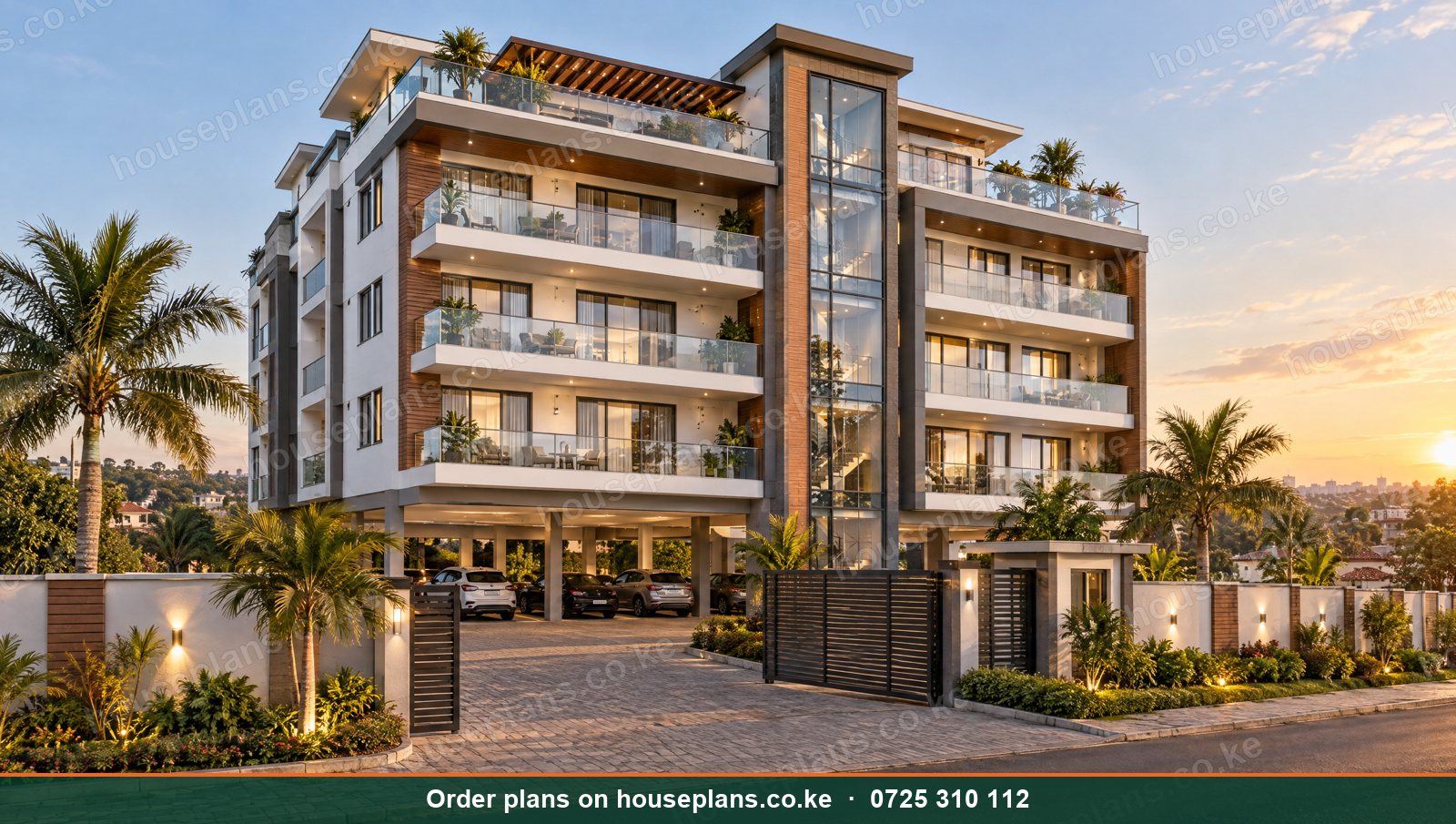
Multi-storey apartment building plans in Kenya power the transformation of our cities. In Kilimani, Kileleshwa and Westlands, old bungalows have given way to towers of eight, ten and more floors. Meanwhile, Ruaka, Kasarani, Roysambu, Syokimau and Kitengela are filling with four- to six-storey blocks. Consequently, apartment design has become one of the most important skills in Kenyan architecture. A well-planned block earns strong rents for decades, while a poorly planned one struggles with vacancies, maintenance and safety problems.
This guide explains how to design multi-storey apartment buildings in Kenya. We cover 4, 5, 6, 8 and 10 storey blocks, unit mixes, lifts, stairs and fire escapes, parking, rooftop amenities, structure, services, zoning, approvals and costs. Additionally, we compare locations and share tips for keeping units let.
Talk to an architect today
Call 0725 310 112 or chat with us on WhatsApp. Send your plot size, county and the number of bedrooms, and we will reply with a quote the same day.
Why Build Multi-Storey Apartments?
More Units Per Plot
Land is expensive. Therefore, building upwards spreads the land cost across many units. For example, a 50×100 plot that holds one family home could hold twelve to twenty apartments where zoning allows.
Strong Rental Demand
Kenya's cities keep growing. Consequently, demand for apartments near jobs, schools and transport remains strong.
Sectional Title Sales
Apartments can be sold individually with sectional titles. As a result, developers can sell units off-plan to fund construction. Read about land and planning documentation.
Apartment Blocks by Height
3 and 4 Storey Blocks
Three- and four-storey blocks are common in satellite towns. They often avoid lifts, which keeps costs down. However, top-floor units may rent for slightly less without a lift. Our Umoja apartments are a 3 storey, 12-unit design for a 50×100 plot. Browse 4 storey building plans.
5 and 6 Storey Blocks
Five- and six-storey blocks usually need a lift and more robust fire safety. They suit Ruaka, Kasarani, Roysambu and Kileleshwa. For example, our Kasarani apartments offer 20 units over five floors, while our Westlands residences offer 24 luxury units over six floors. Browse 5 storey and 6 storey building plans.
8 and 10 Storey Towers
Taller towers suit high-density zones such as Kilimani, Kileleshwa, Westlands and parts of Upper Hill. They need multiple lifts, pressurised or protected escape stairs, sprinklers in many cases, basements and strong structural systems. Consequently, they demand experienced design teams and larger budgets.
Typical Floor Layouts
Most Kenyan apartment blocks follow a few proven layouts. For example, a central stair and lift core with two to four units per floor works well on 50×100 plots. Consequently, each unit gets windows on at least two sides. Alternatively, a long block with an open walkway along one side suits narrow plots and warm climates. Meanwhile, larger sites may use an L-shaped or U-shaped block around a courtyard, which brings light and air to every unit. Additionally, placing bathrooms and kitchens in stacked positions simplifies plumbing on every floor. As a result, construction is faster and maintenance is easier.
Planning Unit Sizes
Typical unit sizes in Kenya vary by market. For instance, a studio may be about 25 to 35 m², a one bedroom unit about 40 to 55 m², a two bedroom unit about 60 to 90 m² and a three bedroom unit with DSQ about 110 to 160 m². However, upmarket areas expect larger units, while affordable projects use compact layouts. Therefore, match unit sizes to local rents and buyer budgets.
Choosing the Unit Mix
Studios and Bedsitters
Studios suit students, young professionals and short-stay rentals. They earn high rent per square metre.
One Bedroom Units
One bedroom units are the most flexible. They suit singles, couples and Airbnb hosts.
Two Bedroom Units
Two bedroom units attract small families and sharing professionals. Moreover, they are the most common in satellite towns.
Three Bedroom Units and DSQs
Three bedroom units with DSQs suit families in upmarket areas such as Kilimani, Kileleshwa and Lavington.
Mixed Blocks
Many blocks mix unit types to spread risk. For instance, our Githurai rentals mix bedsitters and one bedroom units. Read about apartment and rental building plans.
Vertical Circulation: Stairs and Lifts
Staircases
Every apartment block needs at least one protected staircase. Moreover, taller buildings and larger floor plates need two, so residents can escape if one is blocked. Stairs need fire doors, handrails, lighting and minimum widths. Read about staircase, window and door designs.
Lifts
Lifts become essential above four or five floors. They improve access for older residents and people with disabilities. Consequently, upper floors rent better. Lift shafts, pits, machine rooms and power supply must be planned from the start. Additionally, a backup generator keeps lifts running during outages.
Corridors and Lobbies
Corridors should be wide, well lit and naturally ventilated where possible. Meanwhile, an attractive ground-floor lobby with mailboxes and a caretaker's desk creates a good first impression.
Fire Safety in Apartment Buildings
Fire safety is critical in multi-storey buildings. Therefore, designs include fire-rated stairs and doors, compartmentation between units, smoke detection, alarms, hose reels, extinguishers, emergency lighting, wet or dry risers in taller buildings and sometimes sprinklers. Moreover, travel distances to escape stairs must meet regulations. Consequently, the county fire department reviews the design. Read about MEP drawings in Kenya.
Parking for Apartments
Counties set parking ratios for apartments, often one or more spaces per unit depending on size and zone. Therefore, parking often decides how many units fit on a plot.
Surface Parking
Surface parking is cheapest but uses land.
Stilt Parking
Raising the building on columns frees the ground floor for parking. Consequently, it is very common in Kilimani and Kileleshwa.
Basement Parking
Basements free the whole site for gardens and amenities. However, they need excavation, waterproofing, ventilation and ramps, which add cost. Read about garage, carport and driveway designs.
Rooftop and Shared Amenities
Amenities help apartments stand out. For example, rooftop terraces, gyms, swimming pools, children's play areas, lounges, co-working spaces and backup power all attract tenants. However, every amenity adds service charges. Therefore, match amenities to your market. In Kilimani, rooftop pools and gyms are expected, while in Kitengela, secure parking and reliable water matter more. Read about outdoor living designs.
Structure for Multi-Storey Buildings
Multi-storey buildings use reinforced concrete frames with columns, beams and slabs. Taller towers may add shear walls or cores for stability. Moreover, foundations range from pads and rafts to piles, depending on the soil and loads. Consequently, a soil investigation is essential. Read about foundation designs in Kenya.
Slab choices matter too. For instance, hollow pot or ribbed slabs reduce weight and cost. Additionally, a regular structural grid that suits both parking below and apartments above saves money.
Services for Apartment Blocks
Water
Apartments need large underground storage, booster pumps, rooftop tanks and often a borehole. Moreover, individual water meters avoid disputes. Read about water and power planning.
Power
Each unit needs a prepaid meter, while common areas need a landlord's supply and a generator. Additionally, large blocks may need a transformer.
Drainage
Drainage stacks serve each floor, connecting to sewers or treatment systems. Consequently, accessible ducts help maintenance.
Waste
A refuse chamber or collection point near the gate keeps the compound clean.
Security
Controlled entrances, CCTV, intercoms, a caretaker's room and good lighting protect residents. Read about home security design.
Zoning and Approvals
Zoning controls the number of floors, plot coverage, plot ratio and use. For example, Kilimani and Kileleshwa allow taller buildings than Karen or Runda. Therefore, confirm zoning first. Additionally, apartment projects need building approval, structural approval, fire approval, NEMA approval and NCA registration. Taller buildings may need civil aviation clearance near airports. Read about building plan approval costs by county.
Apartment Hotspots in Kenya
Nairobi
Kilimani, Kileleshwa and Westlands lead high-rise development. Meanwhile, Kasarani, Roysambu and Embakasi have many mid-rise rental blocks.
Kiambu
Ruaka, Ruiru, Juja and Kikuyu have booming apartment markets.
Machakos and Kajiado
Syokimau, Athi River, Kitengela and Ongata Rongai have growing demand.
Other Cities
Nakuru, Eldoret, Kisumu and Mombasa are seeing more apartment blocks. Our Eldoret apartments suit these markets.
Designing Apartments That Let Fast
Layout Efficiency
Tenants pay for usable space, not corridors. Therefore, efficient layouts keep circulation short and rooms well proportioned. For example, an open-plan lounge and kitchen with a balcony feels larger than separate small rooms.
Natural Light and Ventilation
Every habitable room needs a window. Consequently, deep floor plates need light wells or courtyards. Cross-ventilation keeps units cool, especially in Mombasa, Kisumu and Machakos.
Balconies
Balconies add outdoor space for drying clothes, plants and relaxing. Moreover, they shade windows below.
Kitchens and Storage
Practical kitchens with good storage, a pantry or a utility area attract families. Read about kitchen layouts for Kenyan house plans.
Bathrooms
Ensuite master bedrooms are now standard in two and three bedroom units. Read about all ensuite house plans.
Finishes
Durable, neutral finishes appeal to the most tenants and reduce maintenance. Read about interior finishes and joinery drawings.
Redeveloping Old Bungalows Into Apartments
In zones where density has increased, old bungalows on large plots can be replaced with apartment blocks. For instance, in Kilimani, Kileleshwa, Lavington and parts of Eastlands, redevelopment often multiplies rental income. However, it requires demolition permits, possibly change of user, tenant notices and careful financing. Read about renovation and extension plans in Kenya and house plans in Eastlands Nairobi.
Financing Apartment Projects
Developers fund apartments through savings, bank construction loans, joint ventures with landowners and off-plan sales. Lenders typically require approved plans, a BQ, a feasibility study and evidence of pre-sales or expected rents. Consequently, a professional design package is essential. Read about mortgage and SACCO loan house plans.
Joint Ventures With Landowners
Many apartment projects are joint ventures. A landowner contributes the land, while a developer funds design and construction. Then they share the units or the sales proceeds. Therefore, clear legal agreements, approved designs and transparent BQs protect both sides.
Common Apartment Design Mistakes
Ignoring Parking Ratios
Designs with too little parking get rejected or struggle to let. Plan parking first.
Dark, Deep Units
Units without enough windows feel gloomy and rent poorly. Use light wells.
Weak Water Supply
Upper floors without pressure frustrate tenants. Plan pumps and storage properly.
Too Many Amenities
Expensive amenities raise service charges beyond what tenants will pay. Match them to the market.
Affordable Housing Apartments
Kenya's affordable housing drive has created demand for efficient, low-cost apartments. Consequently, designs focus on compact one, two and three bedroom units, repetitive layouts, simple structures and durable finishes. For example, standardised floor plans, precast elements and hollow pot slabs reduce costs. Meanwhile, shared amenities such as playgrounds, community halls and shops serve residents. Developers partnering with government programmes must meet specific standards. Read about alternative building technologies in Kenya.
Serviced Apartments and Short Stays
Serviced apartments combine the space of an apartment with hotel-style services. They suit business travellers, expatriates and families relocating to Nairobi, Mombasa or Kisumu. Therefore, they need a reception, housekeeping storage, laundry, Wi-Fi, security and furnished units. Similarly, many investors run apartments as Airbnbs. As a result, design for easy cleaning, secure self check-in and durable furniture. Read about Airbnb and holiday home plans.
Sustainability in Apartment Blocks
Apartment blocks use a lot of water and power. Consequently, efficient design lowers service charges, which attracts tenants. For instance, solar water heating on the roof, rainwater harvesting, LED lighting in common areas, efficient pumps and good natural ventilation all cut costs. Moreover, green-certified apartments may attract green mortgages and higher rents. Read about eco-friendly house plans in Kenya.
Maintenance and Long-Term Value
Buildings age. Therefore, design for easy maintenance. For example, accessible ducts for pipes and cables, durable façade finishes, quality roofing and robust common-area finishes keep repair costs low. Additionally, a well-planned management office, store and caretaker's room help daily operations. Consequently, the building keeps its value and appeal for decades.
Construction Costs
Typical 2026 construction costs for apartments are:
| Building | Approximate cost per m² |
|---|---|
| 3–4 storey block, basic to standard | KSh 40,000 – 50,000 |
| 5–6 storey block with lift | KSh 48,000 – 65,000 |
| 8–10 storey tower with basement | KSh 60,000 – 85,000+ |
These exclude land and fees. For example, a 1,850 m² five-storey block might cost roughly KSh 89M to 120M. A BQ gives exact figures. Use our building cost calculator.
Apartment Development Checklist
First, confirm zoning, plot ratio, height limits and parking ratios. Next, study local rents, vacancy rates and the most popular unit sizes. Then commission a soil investigation. After that, design the unit mix, parking, lifts and services together, and prepare a BQ. Finally, coordinate county, fire, NEMA and NCA approvals, and plan sectional titles if you will sell units. As a result, your block is approvable, buildable and profitable.
Our Services for Multi-Storey Apartment Building Plans
Apartment Architectural Design
We design 3 to 10+ storey apartment blocks with efficient layouts. Consequently, you maximise lettable area within zoning limits.
Our architect checks zoning, parking ratios and the local rental market first.
Feasibility Studies
We test unit mixes, floor counts and parking options to find the best return.
Consequently, you build what your market will rent or buy.
Structural Engineering
We design frames, cores, slabs and foundations, including basements and piles.
As a result, the structure is safe, efficient and approvable.
MEP and Fire Engineering
We design lifts, water, power, drainage, fire detection, risers and sprinklers.
Therefore, the block runs reliably and meets fire department rules.
Approvals Coordination
We coordinate county, fire, NEMA, NCA and aviation approvals.
Approvals run in parallel to save months.
Sectional Plan Drawings
We prepare drawings suitable for sectional titles, so units can be sold.
Buyers and mortgage lenders prefer units with their own titles.
3D Renders for Sales
We produce renders and walkthroughs for off-plan sales and financing.
Talk to an architect today
Call 0725 310 112 or chat with us on WhatsApp. Send your plot size, county and the number of bedrooms, and we will reply with a quote the same day.
Plan Your Apartment Building
Call or WhatsApp 0725 310 112, or email info@houseplans.co.ke. Our office is in Nairobi, and we serve every county.
Browse our apartment plans, read about mixed-use building plans, or order your plan.
Frequently asked questions
How many apartments fit on a 50×100 plot in Kenya?+
Typically 12 to 24 units, depending on zoning, unit sizes, floors and parking rules.
When does an apartment block need a lift?+
Generally above four or five floors, and lifts improve rents and accessibility even in shorter blocks.
How much does a 5 storey apartment block cost in Kenya?+
Roughly KSh 48,000 to 65,000 per m² in 2026. A 1,850 m² block might cost KSh 89M to 120M.
Can apartments be sold individually?+
Yes. Under the Sectional Properties Act, units can have sectional titles.
What approvals do apartments need?+
County building, structural and fire approvals, NEMA approval, NCA registration and sometimes aviation clearance.
Related searches
- Multi-storey apartment building plans in Kenya
- 4 storey apartment building plans Kenya
- 5 storey apartment building plans Kenya
- 6 storey apartment building plans Kenya
- 8 storey apartment building plans Kenya
- 10 storey apartment building plans Kenya
- Kilimani multi storey apartment plans Kenya
- Kikuyu town multi storey apartment plans Kenya
- Apartment house plans Kenya
- Multi-storey house plans Kenya
- Investment house plans Kenya
- Rental house plans Kenya
- Commercial house plans Kenya
- Structural house plans Kenya
- 3 bedroom house plans in Kenya
- 3 bedroom house design in Kenya
- Low cost simple 3 bedroom house plans in Kenya